Introduction
Technology is the heartbeat of human progress. Every tool, every invention, and every breakthrough has shaped the course of civilization — from the first stone tools that sparked the dawn of human ingenuity to the algorithms that now power artificial intelligence. Over centuries, the concept of “technology” has evolved from mere mechanical devices to complex systems that can think, learn, and even predict human behavior. The story of technology is not just about machines; it is about humanity itself — our curiosity, creativity, and constant desire to make life easier, faster, and more efficient.
As we move deeper into the digital and intelligent age, it is vital to reflect on how technology has evolved, how it has reshaped our world, and what the future might hold. This exploration will take us from the early days of the Industrial Revolution to the current landscape dominated by artificial intelligence, robotics, and quantum computing.
The Birth of Modern Technology: The Industrial Revolution
The Industrial Revolution of the 18th and 19th centuries marked the true beginning of modern technology. Before this period, human labor and animal power were the main sources of production. With the invention of the steam engine, the spinning jenny, and mechanized looms, production processes were transformed forever. Factories began to replace workshops, and efficiency became the new measure of success.
This era introduced not only machines but also the concept of technological progress as a driving force of economic and social change. The steam engine revolutionized transportation through railways and steamships, while advances in metallurgy and engineering led to the creation of bridges, tunnels, and industrial cities. The Industrial Revolution demonstrated the incredible potential of technology to reshape human society — but it also introduced the first warnings about inequality, environmental damage, and the displacement of workers.
The Age of Electricity and Communication
By the late 19th and early 20th centuries, the next wave of innovation was powered by electricity. The discoveries of scientists like Thomas Edison and Nikola Tesla opened doors to an electrified world. Light bulbs illuminated homes and streets, electric motors powered factories, and new communication systems began to shrink the world.
The invention of the telegraph, and later the telephone, revolutionized human communication. For the first time, people could send messages across continents in seconds. This marked the beginning of global connectivity — a concept that would later define the 21st century. At the same time, the development of the radio and eventually the television allowed information, entertainment, and education to reach mass audiences, changing culture and politics forever.
The age of electricity was not only about power but about connection. It created a world where ideas could travel instantly, laying the foundation for the information technologies that would soon follow.
The Digital Revolution and the Rise of Computers
The mid-20th century witnessed another seismic shift — the rise of digital technology. The invention of the computer changed everything. Initially built for complex calculations during World War II, early computers like ENIAC were massive machines that filled entire rooms. Over time, advances in transistors and microprocessors made them smaller, faster, and more powerful.
By the 1970s and 1980s, personal computers began to enter homes and offices. Companies like IBM, Apple, and Microsoft transformed computing from a specialized field into an everyday necessity. The computer became the ultimate productivity tool, automating tasks that once required days or weeks of manual labor.
More importantly, the digital revolution changed how people thought about information. Data became the new currency. Storing, analyzing, and transmitting information became central to business, education, and science. Software evolved as a new form of technology — intangible yet powerful — shaping how humans interacted with machines and each other.
The Internet Revolution: A Connected World
In the 1990s, the world witnessed one of the most transformative inventions in human history: the Internet. What began as a network for scientists and researchers quickly expanded into a global system connecting billions of people. For the first time, knowledge was accessible to anyone with a connection.
Email replaced letters, websites replaced libraries, and e-commerce replaced traditional shopping. The Internet democratized information, giving rise to new industries and social structures. Search engines, social media, and online marketplaces redefined communication, relationships, and business models.
However, this new connectivity also brought challenges. Privacy concerns, misinformation, and cybercrime emerged as new threats. The Internet mirrored human society — capable of great good, but also vulnerable to misuse. Still, its transformative power could not be denied. The digital era had officially begun, and humanity was now living in a connected, data-driven world.
The Mobile Revolution: Technology in the Palm of Our Hands
The early 21st century introduced another milestone: the mobile revolution. Smartphones became the centerpiece of modern life, combining the power of computers with the portability of phones. This transformation allowed people to access the Internet, communicate, and work from anywhere.
The introduction of touchscreens, mobile applications, and cloud computing changed how people interacted with technology. Smartphones became personal assistants, entertainment hubs, and gateways to the digital world. Social media platforms like Facebook, Instagram, and Twitter (now X) reshaped global communication, culture, and politics.
The mobile revolution also created a new kind of economy — the app economy. Millions of developers began building tools for everything imaginable: from fitness tracking to language learning to financial management. Technology was no longer confined to offices or laboratories; it had become an intimate part of everyday life.
The Rise of Artificial Intelligence
Artificial Intelligence (AI) represents the latest and most profound transformation in technology. Although the concept of AI dates back to the 1950s, recent advances in computing power, data availability, and machine learning have propelled it to the forefront of innovation.
AI enables machines to perform tasks that once required human intelligence — recognizing speech, understanding language, driving cars, and even creating art. Machine learning algorithms analyze enormous amounts of data to find patterns, make predictions, and improve over time. This has opened possibilities in fields such as healthcare, finance, education, and entertainment.
For example, AI systems can now detect diseases more accurately than human doctors, optimize supply chains for global corporations, and generate content in multiple languages. However, these capabilities also raise ethical and societal questions. What happens when machines become too intelligent? How do we ensure that AI benefits humanity rather than replacing it? These are the questions that define the technological debates of our time.
Automation, Robotics, and the Future of Work
Automation and robotics are transforming industries at an unprecedented pace. Robots now build cars, sort packages, assist in surgeries, and even deliver groceries. In manufacturing, automation has improved precision and reduced costs. In logistics, autonomous systems manage warehouses and transportation networks with minimal human intervention.
While these advances increase efficiency and productivity, they also reshape the labor market. Many traditional jobs are being replaced by machines, creating both opportunities and anxieties. The challenge for society is to balance technological progress with human well-being. Education and upskilling have become essential to ensure that people can adapt to new forms of work in a technology-driven world.
The future of work will likely involve collaboration between humans and machines — a partnership where automation handles repetitive tasks and humans focus on creativity, empathy, and decision-making.
The Age of Data and the Power of Information
Data is often called the new oil of the digital economy. Every click, transaction, and interaction generates data that companies analyze to gain insights, predict trends, and personalize services. Big Data and analytics have become powerful tools for decision-making across industries.
From targeted advertising to smart city planning, data shapes how organizations operate. Artificial intelligence relies on vast datasets to learn and improve, while cloud computing enables the storage and processing of this information at scale.
However, the explosion of data also brings issues of privacy, security, and ownership. Who controls the data we generate? How is it used? These questions are central to the ethics of technology in the modern era. Governments and corporations are still grappling with how to balance innovation with individual rights.
The Green Technology Movement
As awareness of climate change grows, technology is increasingly seen as both a cause of and a solution to environmental challenges. The industrial and digital revolutions have consumed vast amounts of energy, but they have also inspired innovations aimed at sustainability.
Green technologies such as renewable energy, electric vehicles, and smart grids are transforming how humanity interacts with the planet. Solar and wind energy are becoming more affordable and widespread, while electric transportation promises to reduce emissions. Advances in materials science are creating biodegradable plastics and energy-efficient buildings.
Sustainability has become a driving force in technology development. The future will likely depend on how effectively humanity uses innovation to balance progress with environmental responsibility.
Biotechnology and the Future of Life
Another frontier of technology lies within biology itself. Biotechnology combines science and engineering to manipulate living systems for practical purposes. From gene editing tools like CRISPR to lab-grown organs and synthetic biology, the possibilities are immense.
In medicine, biotechnology is enabling personalized treatments based on genetic information. In agriculture, genetically modified crops promise higher yields and resistance to pests. In environmental science, engineered microorganisms can help clean pollution and produce sustainable fuels.
The convergence of biology and technology blurs the line between the natural and the artificial, raising profound ethical questions about what it means to “design” life. As these technologies mature, they will redefine not only healthcare and agriculture but also humanity’s relationship with nature.
Quantum Computing: The Next Technological Frontier
If classical computers were the engines of the digital revolution, quantum computers could be the engines of the next. Quantum computing leverages the principles of quantum mechanics — superposition and entanglement — to perform calculations far beyond the capabilities of traditional machines.
While still in its early stages, quantum computing promises to revolutionize industries dependent on computation. It could solve complex problems in chemistry, materials science, cryptography, and artificial intelligence that are currently unsolvable. Governments and tech giants alike are investing heavily in this emerging field.
Quantum computing represents the next step in humanity’s quest for greater understanding and control over the physical world. It may one day unlock new scientific discoveries and enable technologies we can barely imagine today.
The Human Side of Technology
Amid all these advances, one truth remains constant: technology is a reflection of human values and choices. Every innovation carries both potential and risk. The same algorithms that recommend entertainment can also reinforce bias; the same networks that connect communities can also spread misinformation.
Technology amplifies human capability — but it also amplifies human flaws. That is why ethics, empathy, and responsibility must accompany innovation. The conversation about technology must include not just engineers and entrepreneurs, but philosophers, educators, and citizens. Only by aligning technology with humanity’s collective good can we ensure a sustainable and equitable future.
The Future Ahead: Merging Humanity and Technology
Looking forward, the boundaries between humans and machines are blurring. Wearable devices, brain-computer interfaces, and augmented reality are bringing technology closer to the human body and mind. The idea of “cybernetic enhancement” — improving human abilities through technology — is no longer science fiction.
At the same time, digital identities, virtual worlds, and metaverses are expanding what it means to “exist” in a technological age. People now live dual lives: one physical, one digital. As artificial intelligence becomes more integrated into daily life, questions about consciousness, autonomy, and purpose will become even more important.
The future of technology is not just about what we can build — it is about who we become. The choices we make today will define whether technology serves humanity or the other way around.
Conclusion
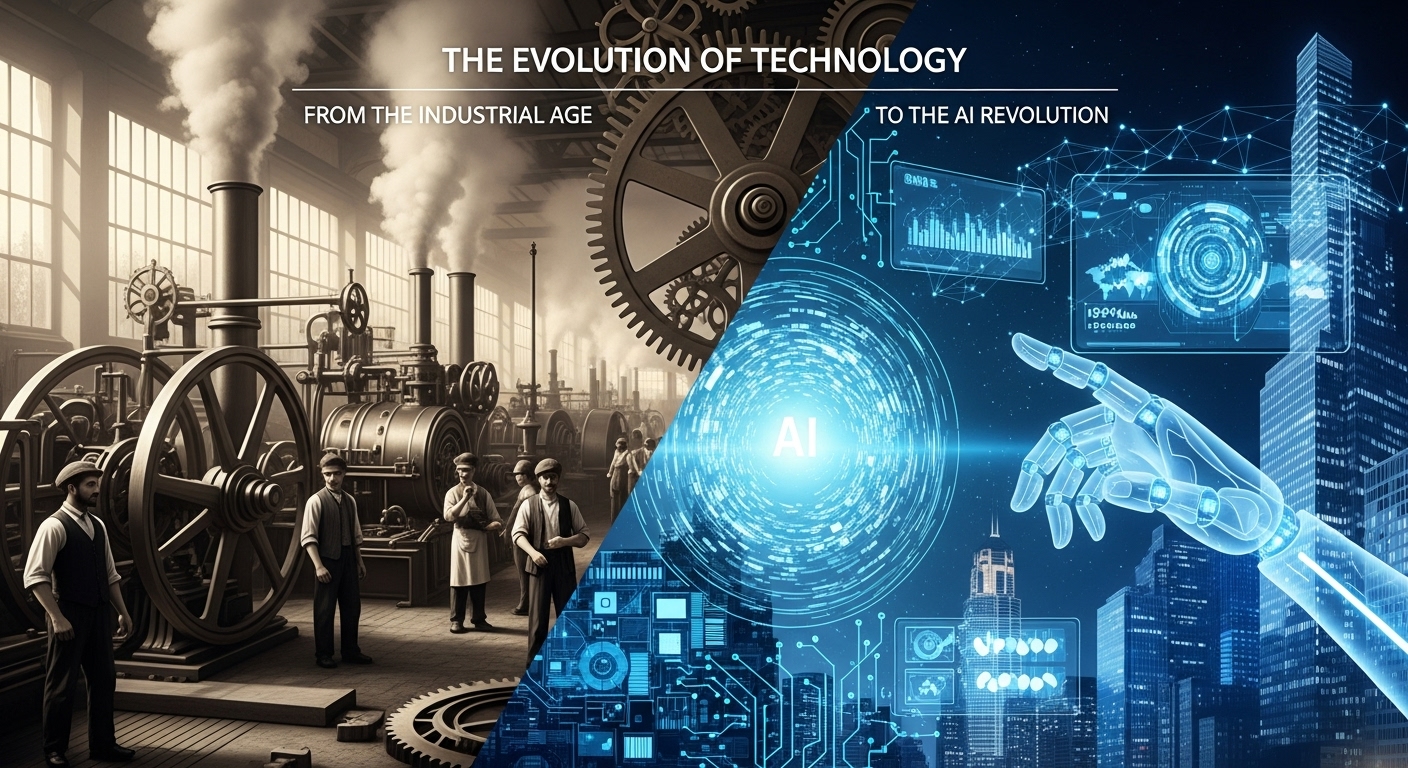
The journey of technology is the story of human evolution itself — from the steam engines of the Industrial Revolution to the algorithms driving artificial intelligence. Each era of innovation has brought both progress and disruption, opportunity and challenge. What began as a quest for efficiency and comfort has become a force capable of reshaping entire civilizations.
As we stand at the dawn of the AI and quantum age, we must remember that technology is not destiny. It is a tool — one that reflects human intention and vision. The future will be defined not by machines, but by how wisely and ethically we choose to use them.
In every sense, technology is the art of transforming imagination into reality. It has carried us from the past into the present — and it will carry us, with all our hopes and fears, into the uncharted possibilities of tomorrow.